Rebuilding Cratered Chests: Complications of Gynecomastia
Posted by Dr. Dadvand February 26, 2026
There is a moment in revision gynecomastia surgery when you stop thinking like a surgeon and start thinking like a sculptor. You are no longer removing something that does not belong. You are rebuilding something that should never have been lost.
That was exactly the situation in a recent revision case I performed. The patient had gone through massive weight loss and then had a lower body lift and gynecomastia surgery at the same time. On the surface, everything should have turned out well. But instead of a smooth, masculine chest, he was left with deep, hollowed-out depressions across his chest wall. The tissue had been removed too aggressively, leaving what we call severe cratering.
This is one of the most difficult and emotionally devastating complications of gynecomastia a patient can experience after surgery.
Why Cratering Happens After Gynecomastia Surgery
Cratering, one of the rare complications of gynecomastia, occurs when too much tissue is removed from beneath the skin during gynecomastia surgery. While the goal is to eliminate unwanted gland and fat, it is equally important to preserve the structural support that keeps the chest looking natural.
When too much is taken, the skin collapses inward. The nipple sinks. The ribs become visible. Light hits the chest in strange ways. From certain angles, the chest can look almost skeletal.
In this patient’s case, the cratering was dramatic, one of the rare complications of gynecomastia. When he sat upright, the left side of his chest dipped deeply inward, much worse than the right. There was very little tissue left between the skin and the rib cage. Even the normal contour of his pectoral muscle was disrupted.
This is where revision gynecomastia surgery becomes less about correction and more about restoration.
The Problem With “Fixing” an Over-Resected Chest
When someone comes in after being over-corrected, the question is not what to remove. It is what is missing.
In almost every cratered chest, the missing element is volume. Specifically, fat.
In some cases, I can use what are called fat flaps. That means rotating nearby fat from surrounding areas into the hollow. It is a powerful technique when there is enough tissue available.
But this patient was lean. He had a prominent rib cage and had already undergone a lower-body lift. There simply was not enough fat nearby to borrow. The crater was too large, and the surrounding tissue was too thin.
That left us with the second option: fat grafting.
Fat grafting allows us to harvest fat from elsewhere in the body, process it, and then inject it precisely where volume is needed. It is one of the most powerful tools we have for revision chest surgery, but it is also one of the most technically demanding.
This is not just filling a hole. This is rebuilding the natural slope and shape of the male chest.
How Fat Grafting Rebuilds a Natural Chest
We harvested fat from his abdomen, flanks, and love handles. Every usable drop mattered. This was not cosmetic liposuction. This was gathering building material for reconstruction.
Once the fat was purified and separated from oils and fluid, I positioned the patient upright. Gravity shows the truth. When a patient sits up, every hollow, every ridge, and every shadow becomes obvious.
I started with the deepest part of the crater. That is always the priority. From there, I layered the fat outward, rebuilding the upper chest first, then blending into the lower and lateral areas to recreate the natural pectoral contour.
Scar tissue from the first surgery made things more challenging. Scar tissue acts like a wall. Fat does not like to stay where scar tissue blocks it. So I carefully released those areas so the grafted fat could settle into the right planes.
This is where surgery becomes art.
Fat grafting is done in hundreds of tiny passes. Small amounts, placed in many layers. That is how you get smoothness. That is how you get survival of the graft. And that is how you make a chest look natural again, instead of patched together.
Why We Overcorrect on the Operating Table
At the end of surgery, the chest looked almost too full. That is intentional.
Fat grafts do not all survive. Especially in revision cases, where blood supply has been disrupted, anywhere from 20 to 60 percent of the fat may resorb over the first few months. That is why we always overcorrect. We build more volume than we ultimately want, knowing some of it will go away.
What remains at around three months is usually permanent.
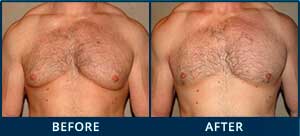
Before surgery, this patient’s chest was sunken and deflated. After surgery, it had a slope again. A fullness in the upper pec. A smooth transition across the chest wall. It did not look perfect yet, but it looked alive again.
That is the difference between removing tissue and restoring form.
Why Revision Gynecomastia Is a Different Kind of Surgery
Revision gynecomastia surgery is not about making things smaller. It is about making things right. It requires judgment, restraint, and an understanding of three-dimensional anatomy that goes far beyond simply removing glandular tissue. You are working with scar tissue, compromised blood supply, and emotional patients who have already been disappointed once.
These are some of the most rewarding cases I do, because you are not just fixing a contour. You are giving someone their body back.
Concerned About Your Chest Appearance? Give Me a Call.
If you are dealing with a cratered, uneven, or unnatural chest after gynecomastia surgery, you do not have to live with it. Revision options exist, even in severe cases.
To learn whether fat grafting or other restorative techniques may be right for you, schedule a consultation with me, Dr. Babak Dadvand, and get a personalized evaluation of your chest anatomy and treatment options.