Gynecomastia Pinch Test: Gland vs Fat Test Before Surgery
Posted by Dr. Dadvand February 25, 2026
If you have ever been told that your chest fullness is just stubborn fat, you are not alone. I see this every week in my practice. Men come in frustrated after dieting, lifting weights, and losing body fat, yet their chest still looks puffy, rounded, or soft. The reason is simple. True gynecomastia is not caused by fat alone. It is caused by firm breast gland tissue that cannot be exercised away.
This is where the gynecomastia pinch test becomes one of the most important parts of my evaluation. It allows me to feel what is really under the skin and determine whether you are dealing with fat, gland, or both. That distinction completely changes how surgery must be performed.
What the Gynecomastia Pinch Test Really Shows
When I perform the gynecomastia pinch test, I am not just squeezing skin. I am comparing thickness and resistance in different parts of the chest. In areas without gynecomastia, the skin and fat pinch thin and soft. In areas with gland, the tissue feels thicker, firmer, and more rubbery.
That difference is not subtle when you know what to look for. The goal of surgery is to make the pinch thickness in the treated area match the surrounding normal chest. When that happens, the contour looks natural and masculine again.
This test is also how I know when I am finished in the operating room. I do not rely on appearance alone, because gynecomastia can hide when a patient is lying down. I rely on what the tissue feels like.
The Chest Angle That Gives Gynecomastia Away
Another thing I evaluate is something most men never notice: the angle of the chest. A masculine chest has a smooth slope from the upper pec down to the abdomen, usually around 150 to 160 degrees. Gynecomastia pushes the skin forward, creating a much sharper angle, often closer to 95 to 100 degrees.
That lower shadow you see on many gynecomastia patients is not from the pectoral muscle. It is created by the breast tissue bulging forward and blocking the light. Once that tissue is removed, the angle opens back up, and the chest looks flatter, tighter, and more athletic.
This is why men who only have liposuction often still look puffy. Fat does not create that sharp angle. Gland does.
Why Liposuction Alone Is Often Not Enough
One of the biggest mistakes in gynecomastia surgery is assuming everything is fat. In reality, most men, especially those who developed gynecomastia during puberty, have a large amount of dense glandular tissue. Liposuction can remove fat, but it cannot remove gland.
That is why I use a combination approach. First, I use VASER liposuction to remove fat and to gently separate the gland from the surrounding tissue. Then, through a small incision, I remove the gland directly. In the case described, nearly three quarters of a pound of tissue came out, and most of it was gland, not fat.
Without removing that gland, the chest would never have flattened properly, no matter how much liposuction was done.
How I Use Flexing to Map the True Borders
Before surgery, I also have patients flex their pectoral muscles. This helps me see where the muscle ends and where the gynecomastia begins. When you flex, the pec tightens and pulls back, but the breast tissue does not. That separation shows me exactly how far the gland extends, sometimes much farther than patients expect.
This allows me to plan where I need to contour, not just in the center of the chest, but toward the sides and upper areas where gynecomastia can hide.
What Real Gynecomastia Correction Looks Like
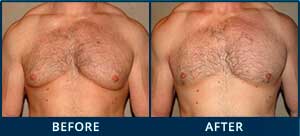
When both fat and gland are treated correctly, the change is dramatic. The chest becomes flatter. The nipple sits naturally. The lower shadow disappears. The chest angle opens back up. And when I perform the gynecomastia pinch test after surgery, the thickness matches the rest of the chest.
That is how I know the job is done properly.
Why Experience Matters in Gynecomastia Surgery
Gynecomastia is not a one-size-fits-all condition. Some men have mostly fat. Others have mostly gland. Many have a mix of both. Knowing the difference is what separates a smooth, masculine result from a chest that still looks soft or puffy after surgery.
This is why I spend so much time examining the chest, using the pinch test, checking the angle, and mapping the tissue with muscle flexion. These small details make a big difference in how natural your result looks. Contact my office if you struggle with gynecomastia and would like to have a smoother, more masculine chest contour.